Proceedings
Back
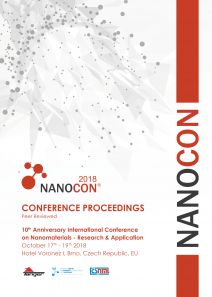

Conference Proceedings - NANOCON 2018
10th International Conference on Nanomaterials - Research & Application
October 17th - 19th 2018 / Hotel Voronez I, Brno, Czech Republic, EU
www.nanocon.eu
ISSN: 2694-930X
Read
more
Past events
Table of Contents
RÖSSNER Pavel Institute of Experimental Medicine, The Czech Academy of Sciences, Prague, Czech Republic, EU, pavel.rossner@iem.cas.cz
Abstract:
Copper (Cu) is a biogenic element that plays an important role in many biological processes. Cu is also used in various industrial products and its nanosized form has antibacterial and antiviral properties. [..]
Read more
SCHUMMER B. University Würzburg, Department for Physics and Astronomy, Chair for X-Ray Microscopy, Josef-Martin-Weg 63, 97074 Würzburg, Germany, bernhard.schummer@physik.uni-wuerzburg.de
Co-authors:
SOCHOR B.
POPOV I.
GERTH S.
Abstract:
This study investigated the stabilization of cadmium sulfide (CdS) nanoparticles in aqueous solutions of the triblock copolymer Pluronic P123. The concentration of the added cadmium sulfide varied between 0.002 and 0.02 M. [..]
Read more
KRAL Petr Institute of Physics of Materials, Academy of Sciences of the Czech Republic, Zizkova 22, 616 62 Brno, Czech Republic
Co-authors:
DVORAK Jiri
SKLENICKA Vaclav
TAKIZAWAA Yoichi
MASUDA Takahiro
HORITA Zenji
KUCHAROVA Kveta
KVAPILOVA Marie
SVOBODOVA Marie
Abstract:
In this study, the effect of severe plastic deformation on grain size refinement and mechanical properties of a coarse-grained steel was investigated. The experimental material used in the present investigation was advanced tungsten modified 9%Cr P92 steel. [..]
Read more
JURMANOVÁ Jana Department of Physical Electronics, Faculty of Science, Masaryk University, Kotlářská 2, 611 37, Brno, Czech Republic, janar@physics.muni.cz
Co-authors:
JAŠEK Ondřej
TOMAN Jozef
Šnírer Miroslav
KUDRLE Vít
Abstract:
Graphene based nanomaterials produced by liquid exfoliation techniques and microwave plasma decomposition of ethanol were studied by scanning electron microscopy (SEM), Raman spectroscopy and X-Ray powder diffraction (XRD). Graphene oxide (GO) and reduced graphene oxide (r-GO) prepared by liquid exfoliation technique consisted of several types of structures - thin flakes with thickness of 10-15 nm and lateral dimensions of several micrometers and graphite like structures, 100 μm in size, with not fully exfoliated graphene layers. [..]
Read more
MORTET Vincent Institute of Physics, Czech Academy of Sciences, v.v.i., Prague, Czech Republic, EU, mortetv@fzu.cz
Co-authors:
LAMBERT Nicolas
HUBÍK Pavel
SOLTANI Ali
Abstract:
Boron-doped diamond exhibits a characteristic S-shaped I-V curve at room temperature [1] with two electrical conductivity states, i.e., low and high conductivity, at high electric fields (50 – 250 kVcm-1) due to the carrier freeze-out and impurity impact ionization avalanche effect. To our knowledge, the carrier multiplication during the change of the conductivity state has not been studied. [..]
Read more
LUKIANOVA Olga Belgorod National Research University, Belgorod, Russia, sokos100@mail.ru
Co-authors:
KOLESNIKOV Dmitrii
KRASILNIKOV Vladimir
KHMARA Alexander
PEREVISLOV Sergey
Abstract:
Silicon nitride find its application in quality of high-temperature ceramics and can be considered as one of the most promising dielectrics. Different properties and microstructure of pressureless sintered silicon nitride have been described a lot. [..]
Read more
KOUDELKOVA Zuzana Department of Chemistry and Biochemistry, Mendel University in Brno, Zemedelska 1, CZ-61300 Brno, Czech Republic
Co-authors:
RICHTERA Lukas
SVEC Pavel
ADAM Vojtech
Abstract:
The environmental contamination by heavy metals is one of the global problems that disturb the ecological balance. A platform for the simultaneous electrochemical detection of trace heavy metal ions has been developed based on the gold nanoparticles-cysteine-multiwall carbon nanotubes (AuNPs-Cys-MWCNTs) modified carbon paste electrode using square wave anodic stripping voltammetry. [..]
Read more
YATSKIV Roman Institute of Photonics and Electronics of the CAS, Prague, Czech Republic, EU, yatskiv@ufe.cz
Co-authors:
BAŠINOVÁ Nikola
GRYM Jan
VANIŠ Jan
Abstract:
We report on the properties of Eu-doped ZnO nanorods prepared by chemical bath deposition from aqueous solutions in an autoclave. The autoclave enables to grow the nanorods above the boiling point of water. [..]
Read more
PANCHENKO Oleg National Technology Initiative Center of Excellence in Advanced Manufacturing Technologies at Peter the Great St. Petersburg Polytechnic University St. Petersburg, Russia, panchenko_ov@spbstu.ru
Co-authors:
CHEN Ke
VILACA Pedro
ISUPOV Fedor
SHAMSHURIN Aleksey
Abstract:
The method of carbon nanotubes (CNT) addition to a friction stir welded dissimilar joint has been developed. The CNT agglomerates are produced in shape of paper sheets. [..]
Read more
LANGER Michal Regional Centre of Advanced Technologies and Materials (RCPTM), Department of Physical Chemistry, Faculty of Science, Palacký University, Olomouc, Czech Republic, EU, michal.otyepka@upol.cz
Co-authors:
PYKAL Martin
OTYEPKA Michal
Abstract:
Graphene is unarguably very promising material for countless applications including also gas sensing. For this particular application, it is very beneficial to understand the nature and strength of interaction of graphene with the adsorbed molecules. [..]
Read more
NABIULLINA Rezida ITMO University, St. Petersburg, Russia, anton.starovoytov@gmail.com
Co-authors:
STAROVOYTOV Anton
GLADSKIKH Igor
Abstract:
The effect of the resonance overlapping of pseudoisocyanine J aggregates exciton and plasmon of the inhomogeneous ensemble of metallic nanoparticles was studied for thin films. The absorption of a hybrid structure was not the sum of the absorption of the cyanine dye layer and nanoparticle extinction. [..]
Read more
HAVLÁKOVÁ Jana Regional Centre of Advanced Technologies and Materials, Departments of Experimental Physics and Physical Chemistry, Faculty of Science, Palacký University Olomouc, Šlechtitelů 27, 783 71, Czech Republic
Co-authors:
TUČEK Jiří
ZBOŘIL Radek
Abstract:
Iron oxides, especially the Fe3O4 and γ-Fe2O3 phases, play a significant role in potential applications of nanomaterials due to their suitable features such as biocompatibility, magnetic and optoelectronic properties. Moreover, it is convenient to use Fe3O4 for some applications, such as Li-ion batteries, because of its combined valence states of iron. [..]
Read more
REMES Zdenek Czech Academy of Sciences, Institute of Physics, Praha, Czechia, remes@fzu.cz
Co-authors:
CHANG Yu Ying
STUCHLIK Jiri
Micova Julia
Abstract:
We have developed the technology of the deposition of the nominally undoped ZnO nanocrystalline thin films by DC reactive magnetron sputtering of Zn target in the gas mixture of argon and oxygen plasma. We have optimized the photoluminescence spectroscopy for measuring optically scattering thin layers with the high sensitivity, precise sample positioning and very low influence of the scattered excitation light. [..]
Read more
Mishonov Todor Sofia University St. Kliment Ohridski, 5 James Bourchier Blvd., BG-1164 Sofia, Bulgaria, EU, mishonov@bgphysics.eu
Co-authors:
Danchev Victor
Varonov Albert
Abstract:
We use the formerly derived explicit analytical expressions for the conductivity of nanostructured superconductors supercooled below the critical temperature in electric field. Computer simulations reveal that the negative differential conductivity region of the current-voltage characteristic leads to excitation of electric oscillations. [..]
Read more
STUCHLIK Jiri Czech Academy of Sciences, Institute of Physics, Praha, Czech Republic, stuj@fzu.cz
Co-authors:
STUCHLIKOVA The Ha
CERMAK Jan
Abstract:
The hydrogenated amorphous silicon layers (a-Si:H) were deposited by PECVD method on quartz substrates. During interruption of PECVD process the vacuum chamber was pumped up to 10-5 Pa and 1 nm thin films of Germanium or Tin were evaporated on the surface. [..]
Read more
TREJBAL Jan,,a Czech Technical University in Prague, Faculty of Civil Engineering, Prague, Czech Republic, EU
Co-authors:
DEMO Pavel,,b
NEŽERKA Václav
SVESHNIKOV Alexey,,d
VALENTOVÁ Tereza
VALENTIN Jan
Abstract:
Pavement structures often fail due to insufficient interphase interaction between bituminous binder and mineral aggregate. A thin bituminous film covering aggregate particles is often replaced by water, resulting in bitumen-water-aggregate system, which is firmly linked to adhesion failure between these materials. [..]
Read more
MAXIMOV Maxim Peter the Great Saint-Petersburg Polytechnic University, Saint-Petersburg, Russia, maximspbstu@mail.ru, carlemeros@gmail.com, yury.koshtyal@gmail.com, rumyantsev.amr@gmail.com popovicha@mail.ru
Co-authors:
NAZAROV Denis
MITROFANOV ILya
KOSHTYAL Yury
RYMYANTSEV Aleksander
POPOVICH Anatoly
Abstract:
In recent years atomic layer deposition has proved to be a successful method of fabrication and modification of electrodes for lithium-ion batteries and thin film power sources. Tin oxide demonstrated considerable excellence over currently used materials for thin film batteries anodes, however, lithiated tin oxides are expected to show even better performance. [..]
Read more
MAMULOVÁ KUTLÁKOVÁ Kateřina Nanotechnology Centre, VŠB - Technical University of Ostrava, Ostrava, Czech Republic, EU, katerina.mamulova.kutlakova@vsb.cz, jonas.tokarsky@vsb.cz
Co-authors:
TOKARSKÝ Jonáš
Abstract:
This study is focused on preparation of pristine zinc sulphide (ZnS) and zinc sulphide/kaolinite (ZnS/K) nanocomposite using one-pot hydrothermal synthesis under atmospheric pressure and without any surfactant. Together with finding a simple preparation method, the aim was to achieve a high photocatalytic activity, and also reduce the environmental risk of ZnS (in the case of ZnS/K). [..]
Read more
KŘÍŽOVÁ Hana Technical University of Liberec, Institute for Nanomaterials, Advanced Technologies and Innovation, Bendlova 1409/7, 460 01 Liberec 1, Czech Republic, EU, hana.krizova@tul.cz
Co-authors:
WIENER Jakub
Abstract:
The surface of the polyester nonwoven fabric was covered with a layer of silver and copper-based nanoparticles obtained from their salts and reduced using tannic acid. Polyester nonwoven MILIFE® without surface modification was used as a carrier of the metallic layer. [..]
Read more
SOCHOROVÁ Lenka Mendel University in Brno, Faculty of Horticulture, Department of Viticulture and Enology, Lednice, Czech Republic, EU, sochor.jirik@seznam.cz
Co-authors:
HOSNEDLOVÁ Božena
DOČEKALOVÁ Michaela
STAŇKOVÁ Martina
UHLÍŘOVÁ Dagmar
RUTTKAY-NEDECKÝ Branislav
KEPINSKA Marta
MILNEROWICZ Halina
BAROŇ Mojmír
NGUYEN Hai Xuan
DUONG Bach Ngoc
NGUYEN Hoai Viet
SOCHOR Jiří
RŮŽIČKA Josef
KIZEK René
Abstract:
The type, number, and magnitude of environmental constraints are currently undergoing changes due to shifts in climate patterns already observed for the past and predicted for the future. These changes are already affecting grape composition with observed changes in sugar and acidity concentrations. [..]
Read more